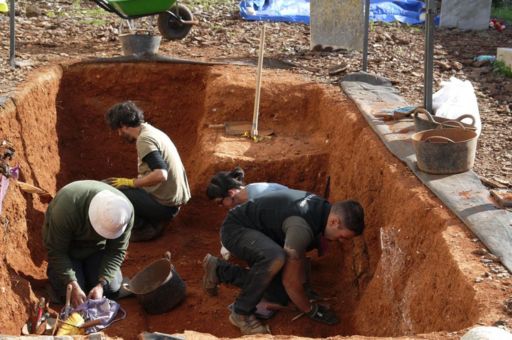
The Government of the Balearic Islands has completed the first operation of the Fifth Mass Graves Plan at the old cemetery of Ses Figueretes, in Eivissa. The excavation work, which began on 18 November, has led to the recovery of human remains and material evidence potentially linked to at least three victims of repression during the Spanish Civil War and the Franco dictatorship.
The intervention was carried out by the Aranzadi-ATICS technical team and forms part of the Balearic Government’s public policies on democratic memory, reaffirming its institutional commitment to locating, exhuming and identifying people who disappeared as a result of political violence.
TDB keeps you informed. Follow us on: Facebook, Twitter and Instagram
Excavations under the Fifth Mass Graves Plan conclude in Ses Figueretes with the recovery of human remains
This campaign represents the fourth exhumation carried out at the Ses Figueretes cemetery and builds on previous phases. In 2024, earlier excavations resulted in the identification of three victims, the first to be officially recognised on the island of Ibiza. The project has been promoted by the Balearic Government in cooperation with the Eivissa City Council and the Fòrum per la Memòria d’Eivissa i Formentera.
A multidisciplinary team of nine specialists in archaeology and forensic anthropology conducted the excavation, focusing on three trenches aligned with those opened in previous campaigns. The intervention area was defined on the basis of historical research and archaeological surveys.
In trench one, researchers documented 22 standard burials and recovered a long-firearm projectile identified as a Spanish Mauser rifle round. Trench two, the largest area excavated, revealed 48 standard burials as well as two groups of disarticulated human remains, including at least three adult skulls showing fractures consistent with gunshot wounds. In this trench, a burial lacking funerary treatment and with an atypical orientation was also identified, along with another firearm projectile—features that may correspond to the victims being sought.
In trench three, 30 standard burials were recorded, together with fragments of a firearm projectile and additional disarticulated human remains that will be examined during forthcoming laboratory analyses.
Overall, the campaign has resulted in the recovery of remains corresponding to a minimum of three individuals. Further forensic anthropology and genetic testing may increase this number and contribute to the identification process.
All work was carried out in accordance with established archaeological and forensic protocols, including stratigraphic manual excavation, detailed photographic and topographic documentation, and individualised recovery of remains.
The conclusion of this intervention strengthens the Balearic Government’s commitment to democratic memory and to restoring dignity to the victims of the Civil War and the Franco regime by facilitating their identification and return to their families.