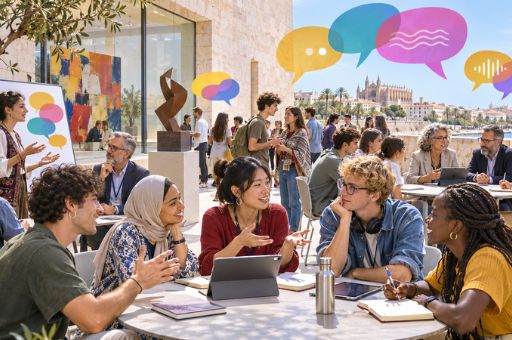
Palma, in the Balearic Islands, is hosting the 2026 NPLD–Coppieters Campus on 12 and 13 November, bringing together nearly 100 participants to examine how young people contribute to the future of regional and minority languages. Held at Es Baluard Museu d’Art Contemporani, the event is supported by the Government of the Balearic Islands.
More than 20 experts are taking part in the programme, entitled “Dissenyant el futur de la diversitat lingüística: el paper dels joves” (Designing the Future of Linguistic Diversity: The Role of Young People).
Researchers, government representatives and specialists from European territories including Italy, France, the Netherlands, Finland, Sweden, Germany and Wales are sharing educational, cultural and digital initiatives aimed at encouraging younger generations to use regional and minority languages.
TDB keeps you informed. Follow us on: Facebook, Twitter and Instagram
Palma hosts European language diversity campus focusing on young people and minority languages. Balearic initiatives and European language projects
Projects presented by organisations in the Balearic Islands form part of the programme, including government educational initiatives promoting Catalan, musical activities organised by the Manangelment Musical Association and campaigns developed by Joves de Mallorca per la Llengua.
Other contributions include MEL, the digital project from IB3, and L’Aferrada, a gathering of content creators organised by Obra Cultural Balear.
The European programme also features experiences involving Frisian in the Netherlands, Welsh in Wales, the Sorbian-speaking community, Basque in the Basque Country, and Swedish and Finnish in Finland.
The University of the Balearic Islands (UIB) is represented through academic presentations examining the relationship between young people and language use.
Catalina Amengual delivers the opening lecture, “Quan el futur de les llengües depèn del futur dels joves: joventut i llengua catalana a les Illes Balears”, exploring the social, economic and digital factors influencing language choices among young people in the Balearic Islands.
Another UIB researcher, Maria de Mar Vanrell, is scheduled to speak at 12 noon on 13 November.
Her presentation, “Més enllà de l’aula: què ens revelen les pràctiques lingüístiques dels joves sobre la política lingüística?”, examines evidence from the Balearic Islands concerning the use of Catalan outside the classroom and the implications for language policy.
Government representatives discuss linguistic diversity
The programme on 13 November opens at 9 am with an institutional roundtable entitled “Dissenyant el futur de la diversitat lingüística”.
Participants include Llorenç Perelló, Director General of Culture for the Government of the Balearic Islands; Aitor Aldasoro, representing the Basque Government; Jeremy Evas, from the Welsh Government; and Anna Jungner-Nordgren, from Finland’s Folktinget.
Further discussions focus on young people’s digital activities, with contributions from Wales and a presentation from Navarra of Sarean Euskaraz, an initiative involving Basque digital culture.
Experiences from Euskararen Etxea and Rafael Dieste educational centre in A Coruña are also included, addressing the promotion of Basque and Galician respectively.
The opening session includes representatives of the Coppieters Foundation and the Network to Promote Linguistic Diversity (NPLD), alongside Jaume Bauzá, the Balearic Islands’ Minister of Tourism, Culture and Sports.
The NPLD Steering Committee also meets during the event to discuss ongoing projects and upcoming activities.
Established in 2007, the network brings together governments, cultural organisations, universities and research centres to support recognition of regional and minority languages and influence European Union language policies.